Poly B Piping in Edmonton: Complete Homeowner’s Guide
If you own an older home in Edmonton, you may have heard the term poly b piping and wondered what it means, how to identify it, and whether it needs to be replaced.
Poly B, short for polybutylene, was once widely used for residential water-supply plumbing. Today, many Edmonton-area homeowners are discovering that their homes still contain this older piping system.
Finding poly b piping in your home does not mean you should panic. However, it is worth understanding what you have, where it is located, how to identify it, and what your options are if you decide to replace it.
This guide explains everything Edmonton homeowners should know about Poly B piping, including identification, common locations, potential concerns, replacement options, costs, and what to expect from a professional plumbing assessment.
What Is Poly B Piping?
Poly b piping is short for polybutylene piping.
Polybutylene was a flexible plastic material used for residential and commercial water-distribution systems. It became popular because it was lightweight, flexible, and relatively easy to install compared with some traditional plumbing materials.
In Alberta, Poly-B was introduced to the construction industry in the mid-1970s and was used in residential and commercial buildings for more than 20 years. Alberta government information states that manufacturers stopped producing Poly-B piping in 1998.
Because Poly B was installed in many homes during this period, homeowners with older properties may still find the material throughout their water-distribution system.
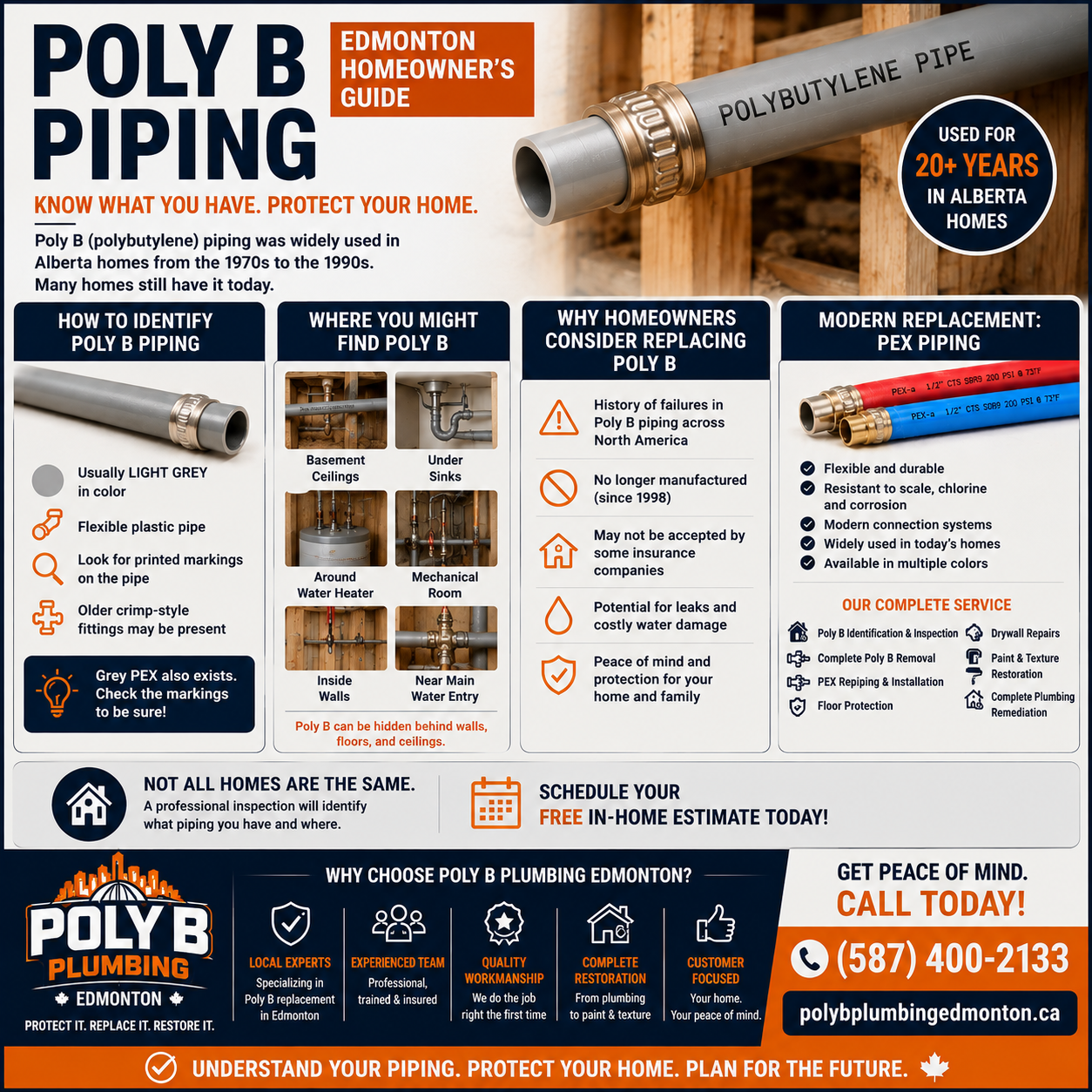
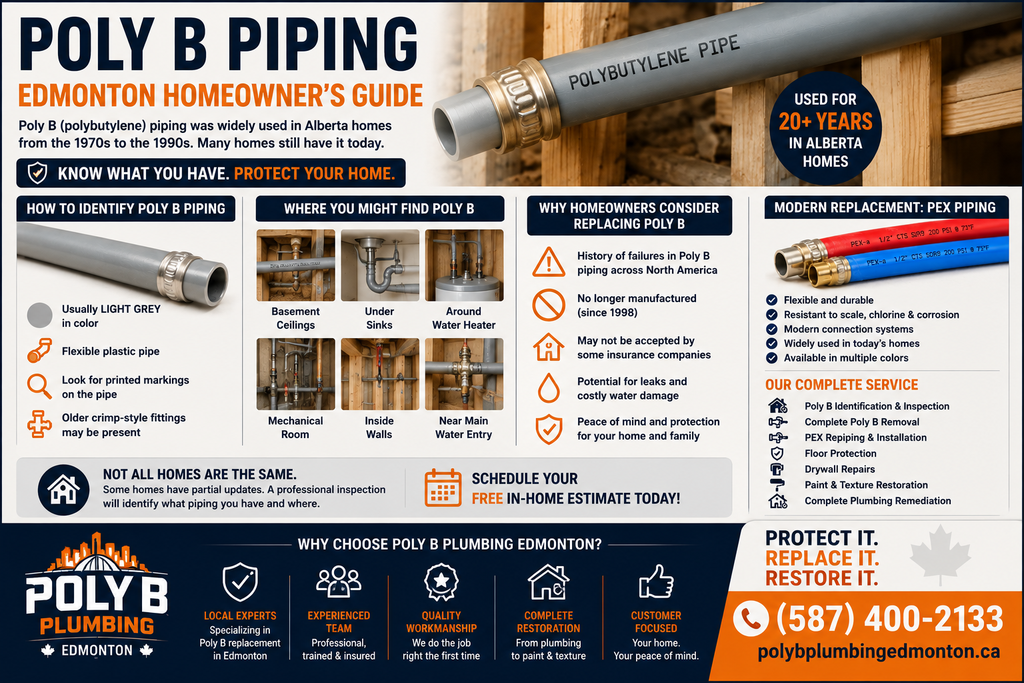
What Does Poly B Piping Look Like?
One of the easiest ways to recognize poly b piping is its typical appearance.
Poly B is commonly:
- Light grey
- Flexible
- Smooth
- Plastic
- Used for pressurized water supply
- Installed behind walls, ceilings, floors, and in unfinished areas
However, colour alone should not be used to identify Poly B.
Modern PEX can also be grey, and older homes can contain several different plumbing materials.
The markings printed directly on the pipe can provide much more useful information.
How Do You Identify Poly B Piping?
If you’re wondering whether your home has poly b piping, start by checking accessible plumbing areas.
Good places to look include:
Basement
An unfinished basement is often one of the easiest places to inspect plumbing.
Look between floor joists and around the mechanical area for flexible grey pipe.
Under Sinks
Check underneath your kitchen and bathroom sinks.
Follow the water lines toward the wall and look for grey flexible tubing.
Water Heater
Inspect the exposed water-supply piping around your water heater.
Be careful not to move or bend older plumbing simply to inspect it.
Mechanical Room
Mechanical rooms often have exposed sections of the home’s water-distribution system.
Main Water Entry
The area around the main water entry and water meter can sometimes provide additional information about the materials used in the home.
Look for Markings on the Pipe
The printing on poly b piping can be one of the most useful ways to identify the material.
Depending on the pipe, markings can provide information such as:
- Manufacturer
- Pipe size
- Material
- Pressure rating
- Certification information
- Product standards
- Date or production information
If you can safely access the pipe, take a clear photograph of the markings.
If you’re unsure what the markings mean, a professional plumber can help identify the material.
Is All Grey Pipe Poly B?
No.
This is an important point for homeowners.
Grey PEX is available, so seeing grey flexible tubing does not automatically mean you have poly b piping.
Other plumbing materials can also appear in older homes.
A professional identification should consider:
- Pipe colour
- Printed markings
- Fittings
- Connection method
- Installation age
- Location
- Overall plumbing system
This is especially important if you’re considering a major replacement project.
When Was Poly B Piping Used?
Poly B became popular in North America during the 1970s and continued to be installed through the 1980s and 1990s.
Alberta government information states that Poly-B was used in the province for more than 20 years and that manufacturers stopped producing it in 1998.
That means the age of your home can provide an important clue.
If your Edmonton home was constructed during the period when Poly B was commonly installed, it may be worth checking accessible plumbing.
However, the construction date alone cannot confirm what material is in the home.
Renovations and previous plumbing repairs can result in a combination of old and new materials.
Can a Home Have Poly B and PEX?
Yes.
Many older homes have undergone renovations over the years.
For example, a homeowner may have replaced the plumbing during a bathroom renovation but left the original poly b piping in the basement.
You could therefore find:
- PEX in one bathroom
- Poly B in the basement
- Copper near another fixture
- Modern supply lines under sinks
Seeing newer plumbing in one part of the house does not mean that the entire home has been repiped.
Where Is Poly B Piping Usually Found?
Poly B may be installed throughout a home’s water-distribution system.
Depending on the property, it can be found:
- In basement ceilings
- Behind drywall
- Inside walls
- Under floors
- Around water heaters
- Under sinks
- Near bathroom fixtures
- Around kitchen plumbing
- In mechanical rooms
- Near laundry areas
- Near the main water distribution lines
Some sections may be easy to access, while others may be concealed.
This is one reason a professional assessment is valuable before planning a replacement.
Why Are Homeowners Concerned About Poly B Piping?
The main concern with aging poly b piping is the possibility of plumbing failure and the water damage that can result.
Alberta government information documents a history of Poly-B pressure-water-piping failures in Canada and the United States.
It also states that Poly-B is no longer listed in current plumbing codes, while noting that plumbing codes are not retroactive.
This distinction matters.
Having Poly B in an older home does not automatically mean that the home is currently violating plumbing requirements.
It does mean homeowners should understand what material they have and consider their options.
Does Poly B Always Fail?
No.
Some homes have had poly b piping installed for many years without experiencing a major plumbing failure.
However, the fact that a system has not leaked does not guarantee that it will never develop a problem.
Homeowners should consider the entire situation, including:
- Age of the piping
- Condition of accessible pipe
- Amount of Poly B remaining
- Fittings and connections
- Insurance requirements
- Future renovation plans
- Plans to sell the property
- Potential water damage
- Cost of replacement
A professional inspection can help you make an informed decision rather than relying on assumptions.
What Are Signs of a Problem With Poly B?
Homeowners should pay attention to signs that could indicate a plumbing problem.
These can include:
- Visible leaks
- Water stains
- Damp drywall
- Discoloured ceilings
- Unexpected moisture
- Corroded or damaged fittings
- Reduced water pressure
- Repeated plumbing repairs
- Unexplained water damage
If you notice active leaking or significant water damage, shut off the water if it is safe to do so and contact a qualified plumbing professional.
Do not wait for a major leak before investigating an aging plumbing system.
Should You Replace Poly B Piping?
There is no single answer for every home.
The decision should be based on the specific plumbing system and the homeowner’s circumstances.
Many homeowners choose to investigate poly b piping because they want to understand the condition and extent of the system before deciding whether replacement makes sense.
Replacement may be particularly worth considering if:
- The home still contains extensive Poly B
- The plumbing is several decades old
- You are planning a major renovation
- You are concerned about potential water damage
- Your insurance provider has specific requirements
- You are preparing to sell
- You want to update the home’s water-distribution system
A professional assessment can help determine the appropriate next step.
What Is Used to Replace Poly B Piping?
PEX is one common modern replacement option for residential water-distribution systems.
PEX is flexible, available in different colours and sizes, and commonly installed in modern residential plumbing.
Depending on the home and project requirements, other materials may also be appropriate.
The best replacement approach depends on the home’s design, plumbing layout, applicable requirements, accessibility, and project scope.
What Does Poly B Replacement Involve?
Replacing poly b piping can be a significant home improvement project.
A typical project can include several stages.
1. Initial Inspection
The plumber identifies accessible Poly B and determines where the material appears to remain.
2. Project Planning
The home’s plumbing layout is reviewed to determine the best approach for installing the replacement system.
3. Protecting the Home
Floors, cabinets, furniture, and other finished areas are protected before work begins.
4. Creating Access
Some Poly B is accessible from unfinished areas.
Other sections may require access through drywall, ceilings, cabinets, or other finished surfaces.
5. Removing the Poly B
The existing poly b piping is removed from the areas included in the replacement project.
6. Installing New Plumbing
New replacement piping, such as PEX where appropriate, is installed according to the planned layout.
7. Testing
The new plumbing system is tested before the project is completed.
8. Restoration
Depending on the project scope, restoration can include drywall repairs, paint, texture matching, and cleanup.
A complete replacement is therefore more than a simple plumbing repair.
It can involve both plumbing and home restoration.
Does Poly B Replacement Require Opening Walls?
Not necessarily.
Every home is different.
Some homes have large amounts of accessible poly b piping in unfinished basements.
Other homes have extensive plumbing hidden behind finished walls and ceilings.
The amount of access required depends on:
- Home design
- Plumbing layout
- Number of floors
- Basement configuration
- Finished areas
- Cabinet layout
- Location of existing plumbing
- Replacement routing
This is why an in-home estimate is much more useful than trying to determine the project cost from photographs alone.
How Much Does Poly B Replacement Cost in Edmonton?
There is no universal price for replacing poly b piping.
The cost can vary significantly between homes.
Factors that can affect the price include:
- Size of the home
- Number of bathrooms
- Number of fixtures
- Number of floors
- Amount of Poly B
- Accessibility
- Finished walls
- Finished ceilings
- Flooring
- Cabinets
- Plumbing layout
- Drywall repairs
- Paint restoration
- Texture matching
- Project complexity
A bungalow with an unfinished basement can have very different access requirements from a two-storey home with finished ceilings.
For this reason, online pricing should be treated as general information rather than an actual quote.
The most accurate way to determine your project cost is with an in-home assessment.
Should You Replace Poly B Before Selling?
Some Edmonton homeowners choose to replace poly b piping before putting their home on the market.
Others wait until a buyer’s inspection identifies the plumbing.
Replacing before selling can give the homeowner more control over the project and allow documentation to be provided to potential buyers.
However, the financial decision depends on the property, project cost, market conditions, and buyer expectations.
If you’re planning to sell, getting a professional estimate can help you understand what you’re dealing with before listing the property.
Should You Replace Poly B Before Buying?
If you’re buying an Edmonton home and discover poly b piping, don’t automatically assume that the property is a bad investment.
Instead, find out:
- How much Poly B remains
- Where it is located
- Whether some areas have already been repiped
- Whether PEX is already installed
- How accessible the plumbing is
- What restoration may be required
- What the estimated replacement cost is
- What your insurance provider requires
Having a professional estimate before finalizing your purchase can give you valuable information for your decision-making and negotiations.
What About Home Insurance?
Insurance requirements can vary between providers and individual properties.
If your home contains poly b piping, speak directly with your insurance provider about your specific situation.
Do not assume that one company’s requirements are the same as another company’s.
If you replace your plumbing, keep documentation such as:
- Invoices
- Scope of work
- Completion documentation
- Applicable permits
- Replacement plumbing information
- Warranty information
Keeping good records can be helpful when selling your home or discussing the plumbing with your insurer.
Why Professional Poly B Identification Matters
It can be tempting to identify poly b piping by looking at the colour of the pipe.
That can be a useful starting point, but it is not enough by itself.
A professional plumber can assess accessible sections and help determine whether the material is Poly B, PEX, copper, or another plumbing material.
This is especially important before spending thousands of dollars on a whole-home plumbing project.
Poly B Piping vs PEX
One of the most common comparisons homeowners make is poly b piping vs PEX.
Poly B is an older material that is no longer manufactured.
PEX is a modern flexible plumbing material commonly used today.
They can both be flexible, and grey PEX can look similar to Poly B.
The key differences include the material itself, manufacturing history, markings, fittings, installation period, and modern use.
If you are considering replacing Poly B, PEX may be one of the replacement options discussed during your plumbing assessment.
Frequently Asked Questions
What is Poly B piping?
Poly B piping is a flexible plastic water-supply pipe made from polybutylene. It was widely installed in residential and commercial plumbing systems from the 1970s through the 1990s.
What colour is Poly B?
Poly B is commonly light grey, although colour alone should not be relied upon for identification.
Is grey PEX the same as Poly B?
No. Grey PEX and Poly B are different materials. Pipe markings and other characteristics should be checked to identify the material correctly.
How can I tell if I have Poly B?
Look for light-grey flexible tubing and inspect the printed markings on accessible sections. A professional plumbing assessment can confirm the material if you’re unsure.
Is Poly B still manufactured?
No. Alberta government information states that manufacturers stopped producing Poly-B piping in 1998.
Is Poly B still used in new homes?
Poly B is an older plumbing material and is no longer manufactured. Modern homes typically use other plumbing materials.
Does Poly B need to be replaced?
Not every situation is identical. Homeowners should consider the age, condition, amount of Poly B remaining, insurance requirements, and their long-term plans.
Can Poly B and PEX be in the same house?
Yes. Renovations and previous repairs can leave a home with a combination of Poly B, PEX, copper, and other plumbing materials.
How long does Poly B replacement take?
The timeline depends on the home’s size, plumbing layout, accessibility, amount of Poly B, and restoration requirements.
Does replacing Poly B damage the house?
Some homes require access through finished walls or ceilings, while other plumbing may be accessible through unfinished areas. A contractor should plan the work to minimize unnecessary disruption and protect finished surfaces.
Can Poly B be replaced without removing drywall?
Sometimes. The amount of access required depends on where the plumbing is located and how the home was constructed.
The Bottom Line
If you have poly b piping in your Edmonton home, the most important thing is to understand what you have and make an informed decision.
Poly B was widely used in older homes and can still be found throughout Edmonton-area properties.
It may be visible in unfinished basements, mechanical rooms, under sinks, around water heaters, or hidden behind finished walls and ceilings.
Because grey PEX can look similar to Poly B, identification should not be based on colour alone.
If you discover Poly B, consider having the system professionally assessed.
You can then understand how much remains, where it is located, what replacement would involve, and what options are available for your home.
Free Poly B In-Home Estimate in Edmonton
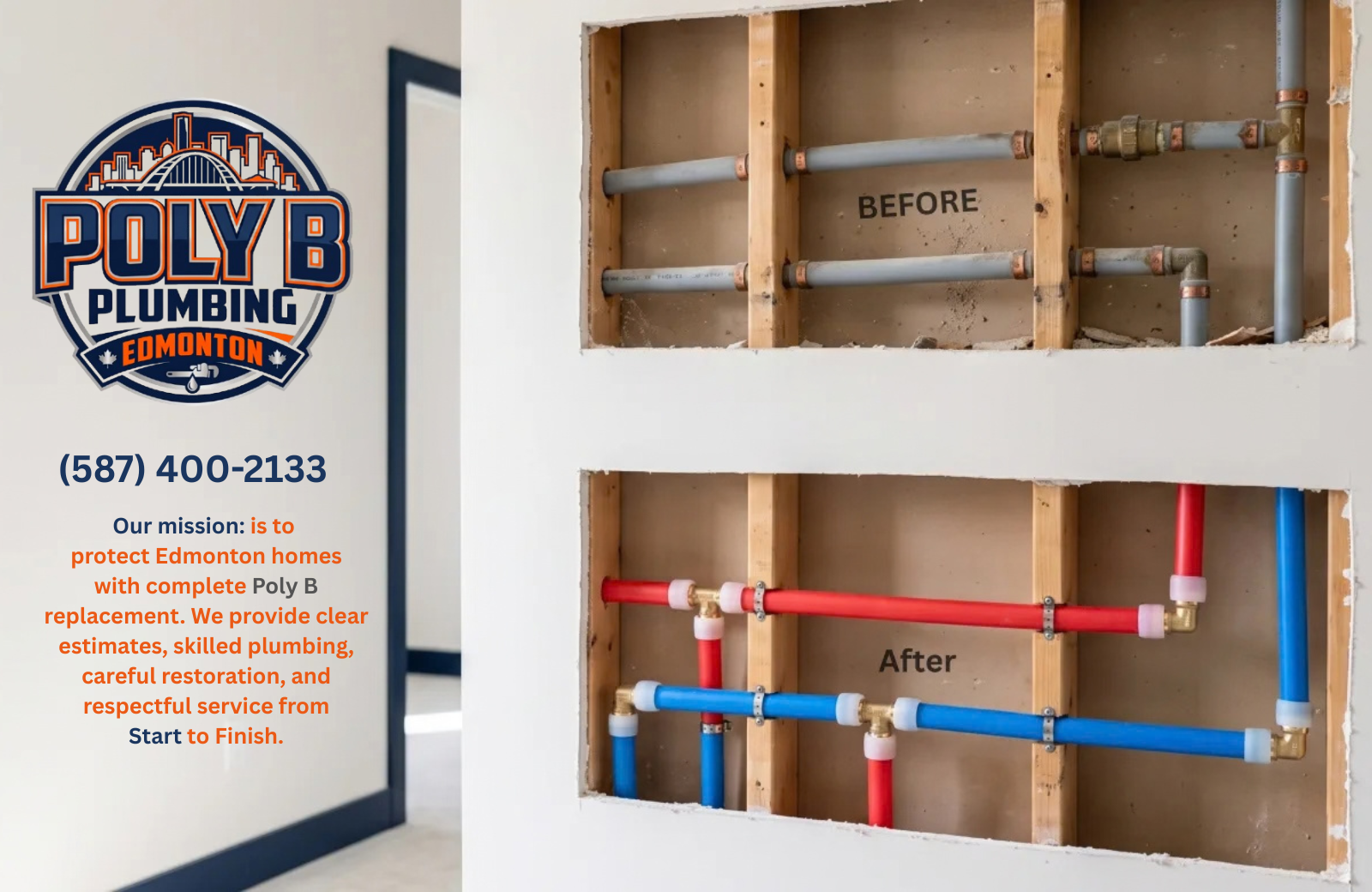
Poly B Plumbing Edmonton specializes in Poly B identification, removal, replacement, and complete plumbing remediation for homeowners, condos, apartments, and multi-unit properties throughout Edmonton.
Our services can include:
- Poly B identification
- Plumbing assessment
- Poly B removal
- PEX replacement
- Floor protection
- Drywall repairs
- Paint and texture restoration
- Complete plumbing remediation
We handle the project from the plumbing replacement through the restoration process, helping homeowners understand what to expect before work begins.
Book Your Free Estimate
If you think your home has poly b piping, you can book a free, no-obligation in-home estimate.
We’ll assess accessible plumbing, discuss your options, and provide a clear estimate based on your property.
Poly B Plumbing Edmonton
📞 (587) 400-2133
🌐 polybplumbingedmonton.ca
Protect It. Replace It. Restore It.